
What Does a Dental X-Ray Show? A Dentist Explains
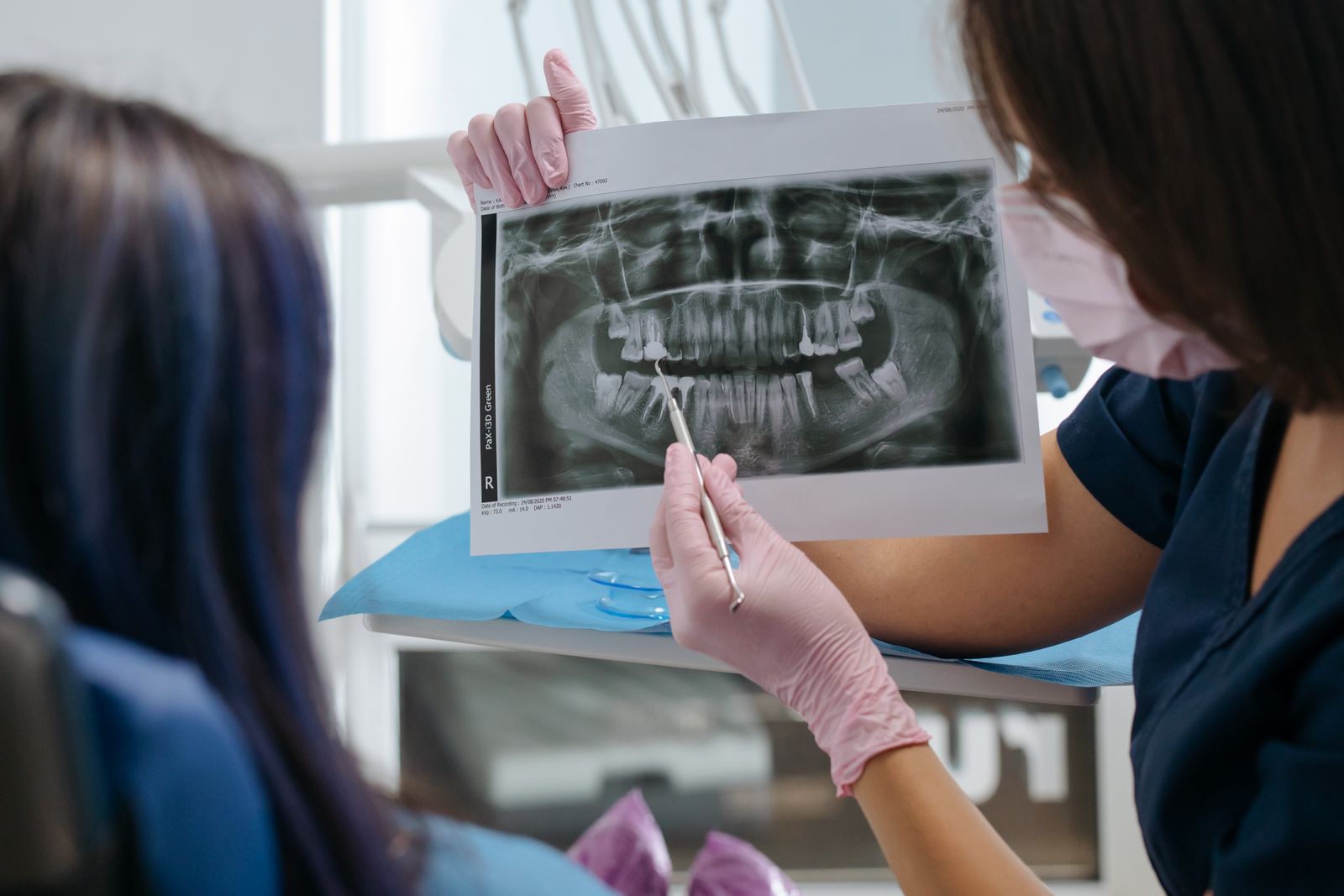
Photo by cottonbro studio via Pexels
What a Dental X-Ray Actually Shows
The eye can only see the surfaces of a tooth that face out into the mouth. An X-ray sees through the tooth and into the bone, which is where a lot of the trouble hides. On a dental film your dentist is reading for:
- Decay between teeth. Cavities that start on the surfaces where two teeth touch are invisible to the eye until they're large. On an X-ray they show up as dark shadows while they're still small enough for a simple filling.
- Decay under a filling or crown. New decay can creep in beneath work that's already there. An X-ray sees under the edge of a filling or crown where the dentist's eye can't reach.
- Infection at the root tip. A dark patch at the end of a root usually means an abscess, and it often appears on film before you feel much of anything.
- Bone level around the teeth. Gum disease eats away the bone that holds teeth in place. An X-ray measures how much of that support is left, which you cannot judge by looking at the gum.
- Impacted or unerupted teeth. Wisdom teeth and adult teeth still under the gum show their angle and whether they're stuck against a neighbour. Our guide to wisdom tooth pain covers when that matters.
- The shape and number of roots. Before a root canal, the dentist needs to see how many canals a tooth has and how they curve, which the step-by-step procedure depends on.
- Cysts and other growths in the jaw. Less common, but a routine X-ray is often how these are first spotted, long before they cause a symptom.
What a Dental X-Ray Can't Show
An X-ray is one tool, not the whole picture, and it has real blind spots. It helps to know what film misses so you understand why a dentist still looks, taps, and asks questions instead of just reading the image.
- Many cracks. A hairline crack in a tooth often doesn't show on an X-ray at all. This is why a tooth that hurts to bite can look completely fine on film. Our guides to a cracked tooth and pain when biting down explain how it's diagnosed instead.
- The very start of gum trouble. Early gum inflammation and bleeding gums are found by looking and measuring the gum, not on film, which only shows bone loss once it has already happened. Our guide to swollen gums covers this.
- Soft-tissue problems. Ulcers, most lumps in the cheek or tongue, and similar issues are found by examination, not by radiograph.
- How much a tooth actually hurts. An X-ray shows damage, not pain. A dead tooth can look quiet on film while it's causing you real trouble.
So the image is read alongside what the dentist sees in your mouth and what you tell them about the pain. A picture on its own doesn't diagnose a tooth.
The Types of Dental X-Ray You Might Have
There isn't one dental X-ray. The dentist picks the view that answers the question they have about your tooth.
- Bitewing. The small film you bite down on. It shows the crowns of the upper and lower back teeth together and is the best view for catching decay between teeth.
- Periapical. Shows one or two whole teeth from the biting surface down to the root tip. This is the view used to study a specific painful tooth, its root, and the bone around it.
- Panoramic. A single wide image of the whole upper and lower jaw in one shot. Good for wisdom teeth, the overall bone, and planning, though less detailed for small cavities.
For complex cases, some clinics also use a 3D scan (a cone-beam CT) to see awkward root canal anatomy or plan an implant. Which one you need depends entirely on the question being asked, not on a set menu.
Are Dental X-Rays Safe?
The radiation from a routine dental X-ray is very low, far below what you're exposed to naturally from the world around you over the same stretch of time. Modern clinics use digital sensors rather than old film, which brings the dose down further and puts the image on a screen within seconds. A lead apron is used as a standard precaution.
That said, an X-ray shouldn't be taken for the sake of it. A good dentist takes one when it will actually change what they do, not on a fixed schedule regardless of whether there's a reason. If you're pregnant, tell the clinic before any film is taken. Routine X-rays are usually postponed, though a genuine emergency is still handled safely with proper shielding. Our guide to a toothache during pregnancy covers how that's managed.
When You Actually Need One, and When You Don't
You don't need a fresh X-ray at every single visit as a matter of habit. If another dentist took one recently, bring it or a photo of it on your phone and you may not need a repeat. Our guide to what to bring to an emergency appointment lists this among the useful things to have.
An X-ray earns its place when:
- A tooth hurts and the cause isn't obvious by looking. Our guide to the symptoms that point to the nerve covers what those look like.
- There's swelling or a suspected abscess that needs its source found.
- You're about to have a root canal, an extraction, or a crown fitted.
- The dentist needs to check for decay hidden between teeth that can't be seen directly.
Here is the honest part. The reason an X-ray is worth the few minutes it takes is that waiting to see whether a problem settles on its own is usually the more expensive choice. A cavity caught as a faint shadow on a bitewing is a small filling. The same tooth left until it aches is often a deep filling or a root canal. Catching it early on film is the cheap version. But a comfortable mouth that was X-rayed recently doesn't need repeat films just because some time has passed, and any dentist pushing a full set of X-rays at every visit with no symptom to justify it is worth a second thought.
Getting Seen and X-Rayed in English in Beit Shemesh
If your Hebrew is fine for the shops but runs thin around root tips and bone loss, you can have the whole thing done in English here. We take a digital X-ray on site, put it up on the screen, and Dr. Joel walks you through what the shadows and shapes actually mean for your tooth. Dr. Joel trained and qualified in the United States, so the explanation happens in a language you're comfortable in, which matters when you're trying to decide what to do about a tooth.
We're in Ramat Beit Shemesh and see patients from across the wider area, not only local residents. You don't need to be registered with us in advance to be seen.
If you've got a tooth that hurts and you want to know what's actually going on inside it, call or WhatsApp 055-985-8845 and send a photo if you have one. We'll take an X-ray only if it'll help, show you what it means on the screen, and give you the cost before anything starts. Our guide to what an emergency visit costs explains how that works. We're in Ramat Beit Shemesh, open Sunday to Thursday 8:00 AM to 8:00 PM and Friday 9:00 AM to 5:00 PM, with after-hours emergency treatment outside those hours. Our emergency dentist, root canal, and same-day treatment pages explain how we handle urgent visits.
For guidance from sources with nothing to sell, the ADA's MouthHealthy explains why and how dental X-rays are taken, and the American Association of Endodontists covers the symptoms behind tooth pain that an X-ray helps pin down.
Common questions
What does a dental X-ray show that the dentist can't see?
Can a dental X-ray show a tooth infection or abscess?
What can't a dental X-ray show?
Are dental X-rays safe?
Do I need a new X-ray at every dental visit?
Can I have a dental X-ray if I'm pregnant?
Still not sure? Message us.
Send Dr. Gabriel Joel, DMD a quick description of what's going on and we'll point you in the right direction.
Message on WhatsAppDentist in Beit Shemesh — our dental clinic