
Why Do I Need a Crown After a Root Canal? The Real Reason
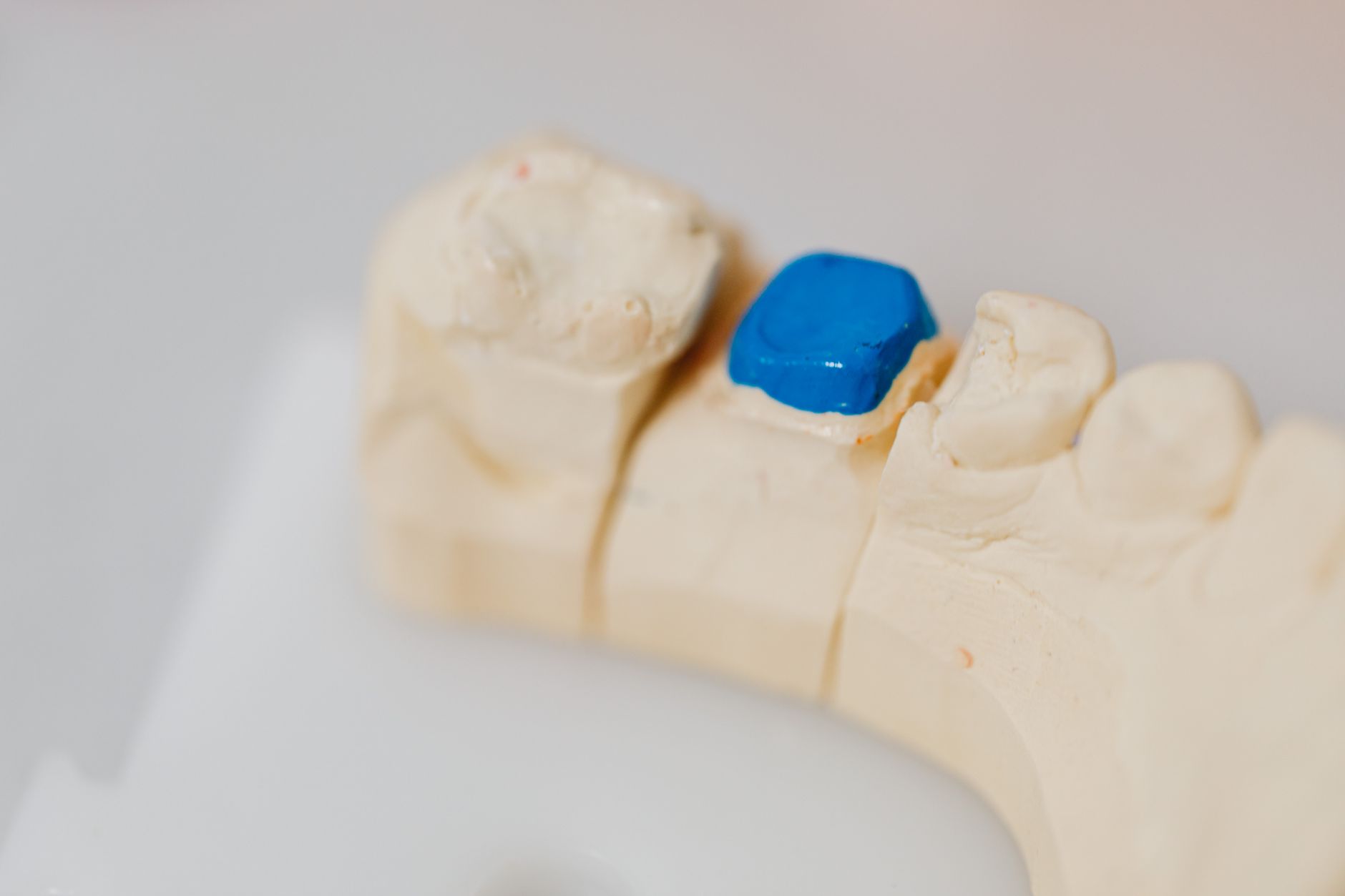
Photo by Kaboompics via Pexels
What actually weakens a root-canalled tooth
The usual explanation is that the tooth dies and dries out, so it goes brittle. That is mostly folklore. A treated tooth does lose its blood supply, but that is not the thing that breaks it.
The thing that breaks it is subtraction. Before a canal can be reached, all of this has to come out:
- the decay or crack that killed the nerve in the first place
- whatever old filling was already sitting in the tooth
- the marginal ridges, the raised walls of enamel running across the top of a molar that join one cusp to the next
- an access hole straight down the middle to find the canals
A back tooth works like an arch. The ridges tie the cusps together so they cannot flex apart under a bite. Take the ridges out and every cusp is standing on its own, hinging a fraction of a millimetre each time you chew. Do that a few thousand times and one of them shears off. A good share of what patients call a failed root canal is a fracture, not an infection.
Why a filling on top usually is not enough
A filling sits inside the hole. A crown sits over the whole tooth. That difference is the entire argument.
Filling material handles pressure well but it does nothing to hold the cusps together. It is a plug, not a strap. A crown covers the cusps and spreads the bite across the tooth as one piece, which is what stops the flexing. Dentists call it cuspal coverage.
Sometimes there is not enough tooth left even to hold a crown, and a build-up goes in first to give it something to grip. Our page on choosing between a crown and a filling walks through the decision, and the one on the post and core build-up explains that extra step.
The teeth that genuinely do not need one
Not every treated tooth gets crowned, and it is worth knowing which ones do not so you can ask the question rather than assume the answer.
- Molars and premolars. Almost always crowned. They do the grinding, they carry the heaviest load, and they are usually the most broken down before treatment even starts.
- Front teeth and canines with intact walls. Often a bonded filling in the access hole is enough. They bite rather than grind, and the hole is small.
- Any tooth that has already lost a cusp. Crown, wherever it sits in the mouth. The arch is broken already.
Nobody can tell you which group your tooth is in over the phone. It depends on how many solid walls survive once the decay is cleared, and that shows up on the X-ray.
What a Friday afternoon in Beit Shemesh does to a temporary filling
Our clinic on Harav Kook 28/1 runs Sunday to Thursday, 8:00 to 20:00, and Friday only until 17:00. Shabbat is emergencies only. That schedule is exactly why we push people not to drift on the crown appointment.
A tooth under a temporary filling is on a clock. Temporary material is built to be taken out again, so it wears down and it leaks. If it crumbles at 11:00 on a Friday you have three hours to get seen. If it crumbles at 15:00 you are carrying an open tooth until Sunday morning. Same-day appointments are possible at the Beit Shemesh clinic, but not on Shabbat.
Booking the crown while the tooth is quiet is unglamorous, and it is the whole trick. Dr Joel trained in the United States and treats in Hebrew and English, so that conversation can happen in whichever language you think in. How long you can safely wait for the crown covers the timing in detail.
What happens if you never get the crown
Two things go wrong, in a fairly predictable order.
First the seal fails. Bacteria work back down past the temporary filling into canals that were cleaned and sealed correctly, and the tooth reinfects. From the outside that looks like a root canal that did not work. Usually the root canal was fine and the roof was left off.
Then the tooth splits. A vertical fracture running below the gum line is generally the end of that tooth. It cannot be crowned, it cannot be retreated, it comes out. That swaps the price of a crown for an extraction and then an implant or a bridge, which is a far bigger bill arriving in a far worse mood.
If the crown is honestly out of reach right now, say so rather than going quiet. There are useful things to do in the meantime, and we have written about what to do when the root canal and crown together cost more than you have.
When it is not us you need
If a dentist you trust crowned the tooth years ago and it has been comfortable ever since, leave it alone. A settled crowned tooth does not need a second opinion because you read something at midnight.
If the tooth was treated, never crowned, and is not hurting, that is a routine appointment rather than an emergency. Book it in normal hours and eat on the other side until then.
Go to a hospital emergency room, not to us, if swelling is spreading toward your eye or down your neck, if breathing or swallowing is difficult, or if there is a fever with chills. That is an infection that has left the tooth, and a dental chair is the wrong room for it.
If you have had a root canal and the tooth is still sitting under a temporary filling, that is the appointment to make this week. Urgent Dental Care is at Harav Kook 28/1 in Beit Shemesh. WhatsApp or call 055-985-8845 and we will tell you whether the tooth needs a crown, a build-up first, or nothing at all. Root canal treatment in Ramat Beit Shemesh and the crown that finishes it are done in the same place, so you get one itemised quote instead of a referral and a second fee.
For sources with nothing to sell you, the American Association of Endodontists explains why saving the natural tooth is worth the work, and the ADA's MouthHealthy has a plain-language page on dental crowns.
Common questions
Why do I need a crown after a root canal if the tooth does not hurt?
Does a root canal really make the tooth brittle?
Can I just have a normal filling instead of a crown?
How long can I leave the tooth before getting the crown?
Can I get the root canal and the crown in the same place in Beit Shemesh?
What if my crowned tooth starts hurting later?
Is the crown included in the price of the root canal?
Still not sure? Message us.
Send Dr. Gabriel Joel, DMD a quick description of what's going on and we'll point you in the right direction.
Message on WhatsAppDentist in Beit Shemesh — our dental clinic