
Knocked-Out Baby Tooth: What to Do and Does It Need Treating
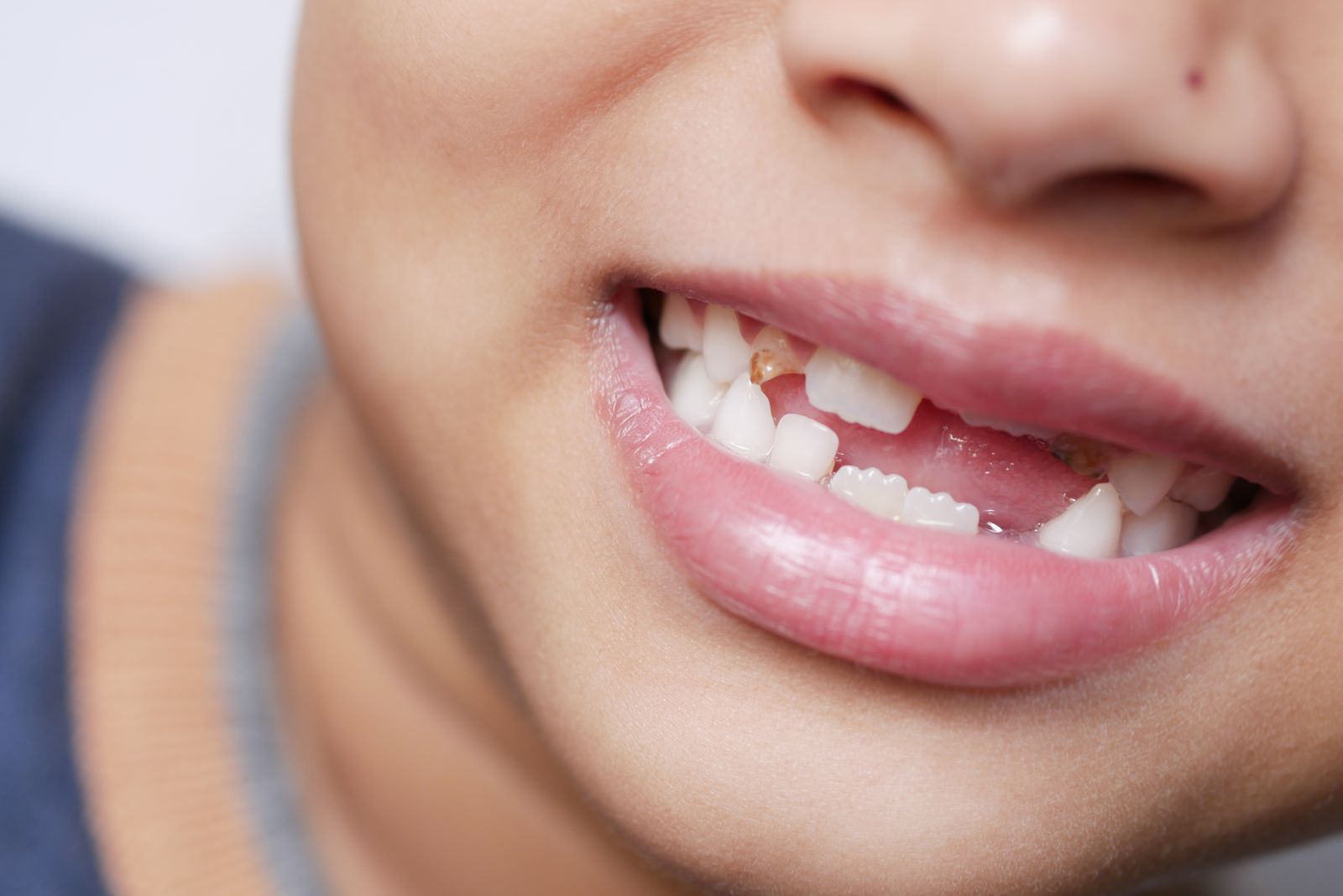
Photo by Towfiqu barbhuiya via Pexels
First, Make Sure It Was a Baby Tooth
The whole answer changes depending on which tooth came out, so this is worth thirty seconds.
- Age is the fastest guide. Under five, it is almost certainly a baby tooth. Over twelve, almost certainly a permanent one. Between six and twelve a child has both in their mouth at once, which is also the age when most playground falls happen.
- Look at the tooth. Baby teeth are smaller and whiter, closer to milk than to bone. A permanent front tooth is bigger, slightly greyer, and a newly erupted one has a bumpy, scalloped biting edge that has not worn flat yet.
- Look at the root. A baby tooth that came out naturally has almost no root left, because the body dissolves it as the adult tooth pushes up. One knocked out early still has its root, so a long root does not by itself mean the tooth was permanent.
If you cannot tell, treat it as a permanent tooth until someone says otherwise. Put it in milk, do not scrub it, and call us straight away, because with an adult tooth the clock genuinely matters and saving a knocked-out tooth is a completely different set of instructions. Being wrong in that direction costs you a phone call. Being wrong the other way can cost the tooth.
What to Do in the First Ten Minutes
Assuming it is a baby tooth, this is the order.
- Sit your child up, leaning slightly forward, so blood runs out of the mouth rather than down the throat. Swallowed blood is what makes children vomit after a mouth injury.
- Press clean gauze or a folded cloth onto the socket and have them bite down on it for ten minutes without lifting it to check. Sockets bleed heavily for the first minute or two and then stop.
- Put something cold on the outside of the lip or cheek, ten to fifteen minutes at a time, to slow the swelling that is coming.
- Find the tooth and keep it. Not in milk, because it is not going back in. A tissue or a small bag is fine. Bring it in so we can confirm the whole tooth is accounted for.
- Children’s paracetamol or ibuprofen, at the dose on the package for their weight and age. Never aspirin for anyone under sixteen.
- Soft, cool food for the rest of the day. No straws, no hot drinks, nothing that has to be bitten into with the front teeth.
Do not push the tooth back into the socket. Do not rinse the socket out hard or poke at it, and keep your child from rinsing vigorously for the first day, because the clot forming in there is doing useful work. The first ten minutes of a dental emergency covers the wider version of this for other injuries.
Why a Baby Tooth Is Never Put Back In
Directly above the root of every baby tooth sits the permanent tooth that will replace it, still forming inside the bone. At that stage it is soft, and it is close.
Pushing a baby tooth back into the socket drives the root down onto that developing tooth. The damage does not show up for years, and when it does it shows as white or brown patches in the enamel of the adult tooth, a misshapen crown, or a tooth that arrives late or crooked. A replanted baby tooth also tends to fuse to the bone or go on to get infected, and if it works loose again it is a small hard object in a small child’s mouth.
So the gap stays a gap. That is not us giving up on the tooth. That is the treatment.
The part that does still need a dentist is confirming the whole tooth came out. A root fragment left in the socket can sit quietly for weeks and then flare as an abscess, and it is not something you can see by looking. Checking for that, along with the neighbouring teeth for cracks and the lip for anything embedded in it, is what the appointment is for.
If It Happens on Friday Afternoon or Shabbat
These calls arrive at the least convenient moment available, which in Beit Shemesh usually means late on a Friday or somewhere in the middle of Shabbat afternoon. Our clinic at Harav Kook 28/1 is open Sunday to Thursday 8:00 AM to 8:00 PM and Friday 9:00 AM to 5:00 PM, and Saturday is emergencies only.
The honest answer for most knocked-out baby teeth is that they can wait until Sunday. Once the bleeding has stopped and your child is comfortable on paracetamol or ibuprofen, there is nothing that needs doing at midnight that changes how this ends. Keep the tooth, keep them on soft food, and call when we open. If anything in the next section applies, that is a different situation and it should not wait.
If you would rather not have to judge it yourself, send a photo. Parents across Beit Shemesh and Ramat Beit Shemesh do this constantly, and being able to describe what happened in English instead of translating a panic into Hebrew makes the triage far more accurate. Usually a picture is enough for us to say whether this is a same-day appointment or a Sunday one, and sending a photo before coming in explains what is useful to include.
When to Skip Us and Go to a Hospital
A knocked-out baby tooth is a dental problem. The fall that caused it sometimes is not. Take your child to a hospital emergency department rather than to a dental chair if any of these apply:
- They lost consciousness, even briefly, or cannot remember the fall.
- They are vomiting, unusually drowsy, confused, or not behaving like themselves.
- There is clear fluid or blood coming from the nose or an ear.
- Bleeding from the socket has not slowed after twenty minutes of firm, uninterrupted pressure.
- There is a deep cut to the lip, tongue or chin that is gaping open or will not stop bleeding.
- The tooth cannot be found anywhere and your child is coughing, wheezing or short of breath. An inhaled tooth needs a chest X-ray, not a dentist.
One more that is easy to misread. If the tooth has vanished but the gum looks more or less intact, it may have been driven up into the bone rather than knocked out. That one is a dentist, and soon, but it is a different injury and it is worth saying so on the phone.
We do treat children for dental emergencies, and a child in real pain moves to the front of the queue, which how we handle children’s dental emergencies goes through. We are not the right place for a head injury.
The Gap, the Speech, and the Adult Tooth Underneath
Once the first day is behind you, the questions change.
- The gap. If your child was around five or six, the adult tooth was on its way regardless and the space will close on its own timetable. Lost much earlier, at two or three, the neighbouring teeth have years to drift, and we will talk about whether anything is worth doing to hold the space. For front teeth the answer is usually no.
- Speech. Parents worry about this more than the evidence supports. Losing a front baby tooth early can change how an s or a th sounds for a while, and it almost always settles by itself as the child adapts.
- The adult tooth. This is the part actually worth watching. An impact hard enough to knock a tooth out can bruise the tooth forming above it, so the permanent one may come through late, slightly discoloured, or with a mark in the enamel. None of that is an emergency, and all of it is easier to handle if someone has been keeping an eye on it.
- The socket. Call if a pimple-like bump appears on the gum in the weeks afterwards, or if the area becomes sore again once it had settled. That usually means a fragment or an infection, and both are quick to deal with.
If your child has knocked out a baby tooth, stop the bleeding first, keep the tooth, and message us once you have a free hand. Call or WhatsApp 055-985-8845. We are at Harav Kook 28/1 in Beit Shemesh, open Sunday to Thursday 8:00 AM to 8:00 PM and Friday 9:00 AM to 5:00 PM, with emergency treatment outside those hours, and we see children for emergency dental care in Ramat Beit Shemesh as well as in Beit Shemesh itself. If the answer turns out to be that it can safely wait until Sunday, we will tell you that too.
For reading from sources with nothing to sell, the ADA’s MouthHealthy covers what counts as a dental emergency, and the American Association of Endodontists explains what happens after a tooth injury.
Common questions
Should I put my child’s knocked-out baby tooth back in?
Does a knocked-out baby tooth need to be treated?
How do I know whether it was a baby tooth or an adult tooth?
How long should the socket bleed after a baby tooth is knocked out?
My child knocked out a baby tooth on Shabbat in Beit Shemesh. Do we need to be seen straight away?
Will the adult tooth still come in normally?
What if my child swallowed the knocked-out tooth?
Still not sure? Message us.
Send Dr. Gabriel Joel, DMD a quick description of what's going on and we'll point you in the right direction.
Message on WhatsAppDentist in Beit Shemesh — our dental clinic